Data communication
Chapter 1 Networking and Telecommunication
Introduction
Telecommunications:
Telecommunications refers to the transfer of information at a far distance. The communication media like telephones, telegrams, radios, and televisions facilitates us to transfer information over a long distance. So communications over a long distance with the help of telephones, mobiles or internet is called telecommunication.
Computer Network:
Network refers to the system of interconnected devices for transferring information from one device to another. Computer network refers to the interconnection of two or more than two computers for data communication. In other words it is also known as the group of interconnected computers for the purpose of sharing resources like computer hardware or software. The Internet is the world's largest computer network where millions of computers are connected across the world for sharing resources like data, hardware or software.
Computer network is created for the following reasons:
To share computer hardware and software.
To share data information.
To make communications.

 |
| Computer Network |
Advantages of Computer Network:
Hardware and software sharing.
Sharing data and files from one computer to another.
Fast and cheap communications.
Sharing of tasks becomes easier .
Creates social networks.
It allows for more convenient resource sharing.
It makes file sharing easier.
It is an inexpensive system.
It increases cost efficiency.
Higher storage capacity.
Disadvantages of Computer Network:
If the security system is not applied on the network, then the data and information may be stolen.
Lack of security leads to virus infection and destruction of computer hardware and software.
Privacy of a user may not be secure.
It increases cybercrime.
Data Communication:
The process of transferring information from one computer to another is known as data communication.
The components of data communications are listed below:
Sender: Sender is the source computer or device which generates and transmits the data.
Receiver: Receiver is the destination computer or device that receives the information or data transmitted by the sender.
Message: It is the information or the data that travels through the communication channel.
Transmission Media: It is the communication channel through which the data travels from sender to receiver.
Protocol: Protocol is the set of rules that controls and handles the communication system. In the network all the computers follow certain rules while communicating which are called network protocol or protocol.
The common protocols that are used on the network are listed below:
TCP/IP: (Transmission Control Protocol/Internet Protocol) is mainly used in the internet to control and manage the transferring of data from one computer to another.
SMTP:(Simple Mail Transfer Protocol) is used for transferring electronic mails from one computer to another.
POP:(Post Office Protocol) is used for receiving emails.
HTTP:(HyperText Transfer Protocol) is used in websites for communication between web browsers and web servers.
FTP:(File Transfer Protocol) is used for transferring files from server to client computers on the network.
IPX/SPX:(Internet Packet Exchange/Sequential Packet Exchange) is used for networking purposes only.
NetBEUI:(NetBIOS Extended user interface) is the network protocol that is used in a small network i.e. LAN(Local Area Network).

Modes of Data Communication:
The way of transferring information from one place to another is known as modes of data communication.
There are three modes of data communication and they are as follows:
Simplex: It is one way communication where transmission of data takes place in only one direction.The transmission of data through radio and television is an example of simplex mode of data communication.

Half Duplex: It is two way communication where transmission of data takes place in both the directions however, only in one direction at a time. Walkie-Talkie is an example of half duplex.

Full Duplex: It is two-way communication where sending as well as receiving information is done at the same time. Telephone, Mobile and computer communications are full duplex.

Bit: Bit stands for the binary digits which is the smallest measuring unit of computer data.
Bandwidth: Bandwidth is the data carrying capacity of a communication channel. In other words, it is defined as the amount of data transmitted per unit time in a communication system. Higher the bandwidth faster the communication will be. It is measured in bits per second (bps) in digital devices whereas it is measured in Hertz in case of analog devices.
Networking Components:
Actually, a computer network is the combination of different components. The Basic components are listed below:
Server: Server is the powerful computer in the network that is the storehouse and distributor of data, information and programs.It controls and provides facilities of sharing computer hardware and software. Server are of two types:
Dedicated Server: Dedicated server is the server computer on the network whose only job is to provide resources to the client computer and control and manage the network . It cannot be used as a workstation.
Non-Dedicated Server: Non-dedicated server controls and manages the whole network and provides resources to the client computers as well as it can be used as a workstation. It acts as a server and a client computer.
Workstation: The computer in the network besides the server that uses all the resources of the network is known as workstation. It is also called a node or a client computer.
Network Adapter: It is a circuit board that physically connects the computer with a network cable. It is also known as NIC- Network Interface Card.
Transmission Media: The communication channel through which the data travels from one computer to another over a network is called transmission media. It is the pathway for transmitting data and information. It may be a cable or a wave. There are two types of transmission media:
Wired Media (Guided/Bounded): The transmission media that uses cables is known as wired transmission media. The path between the sender and the receiver is predefined so it is also known as guided media or bounded media. This transmission media is basically used in a small network.
The types of wired media are listed below:

Coaxial cable: Coaxial cable is similar to the television cable which is covered with black thick insulator. It has a copper wire inside through which data travels. It has very good bandwidth and supports data transfer rate of 10 MBPS or even more.

Twisted Pair Cable: Twisted pair cable consists of pairs of insulated copper wires twisted around each other. It is the most used transmission media for connecting computers on the network. It can be of two types:
Unshielded Twisted Pair(UTP): It has several insulated twisted pairs of copper wire covered with simple plastic cover. It is mostly used in LAN or in Star Topology. It can support data transfer rates from 10 to 100 MBPS.
Shielded Twisted Pair(STP): It is similar to UTP but it has a metallic covering just under the plastic casing. It offers the best protection from interference. It can support data transfer rates from 16 to 500 MBPS.

Fiber Optics Cable: This cable consists of very thin glass fibers surrounded by a protective insulator. The data travels in the form of light so it is the fastest communication media. It can support a data transfer rate of 2 billion bits per second.
Wireless Media (Unguided/Unbounded): Wireless media are the electromagnetic waves like radio wave, microwave, infrared or laser that are used for transmitting data from one computer to another on a network. It is used where cabling is not possible. It is very flexible and also known as unguided or unbounded transmission media. Some commonly used unbounded media are bluetooth, wifi, infrared, microwave, radiowave, satellite.
Difference Between Guided and Unguided transmission Media.
Networking Architecture:
The networking architecture or network model specifies how computers on the network are connected and how they interact with each other. There are two types of network architecture:
Client server network architecture: The network architecture where there is only one dedicated server computer and other are client computers is known as client server network architecture. In this network architecture the server only performs the job of a server. It cannot be used as a workstation in the network.

Advantages of client server network architecture
It provides a high level of security.
The controlling and managing of workstation or client computers are done by powerful centralised server
The size of the network can be expanded to any size very easily.
It can carry a heavy workload.
Disadvantages of client server architecture:
It is very expensive then a peer to peer network.
skilled manpower is required to operate this type of network architecture.
High traffic
Peer to peer network architecture:The network architecture where all the computers on the network act as the server as well as the client is known as peer to peer network architecture. In this network architecture all the computers have equal rights and they can be used as a server as well as a workstation.

Advantages of peer to peer network architecture:
It is very easy to set up.
It is cheaper than client server architecture.
The administering of the network can be done easily.
Disadvantages of peer to peer network architecture.
It cannot handle a heavy workload.
Expansion of the network is limited.
Software needs to be installed in every computer.
Types of Computer Network
The types of computer network are listed below:
LAN- Local Area Network:
Computer network that is spread in a small area such as a room orI building is known as a local area network. It is a small network where computers are usually connected with cables. If the LAN is created with wireless transmission media then it is said to be WLAN wireless LAN.

Features of LAN
It covers a small geographical area.
Cables are used for connecting computers.
It offers higher bandwidth for transmitting data..
It is normally owned by a single organisation.
MAN- Metropolitan Area Network: It is the computer network that is bigger than LAN but smaller than WAN. It covers a city or spread between cities. It helps to create a network between branches of organisation sources, bank officers, schools, etc.

Features of MAN
It covers a larger area than LAN.
It uses wireless media to create networks.
It is owned by a single or multiple organisation.
WAN- Wide Area Network:
The computer network that covers the whole world is WAN. It is the network between countries. It uses telephone lines, microwave, radio waves or satellite links to form such a big network. In WAN many LAN and MAN are connected so it is also called network of networks. The Internet is a wide area network.

Features of WAN
It spreads in the whole world.
It is owned by multiple organisations
It is known as network of networks
It uses wire and wireless media to connect computers.
Network Topology
The physical arrangement of computers or cabling structure of a local area network is known as network topology. It refers to the physical layout of computers in a LAN. It represents the physical connection between the computers and the way of communication between the computers.
Types of Network Topology
Bus Topology: In bus topology all the computers are connected with a single communication channel in a linear format so it is also called linear topology.
Advantages:
It is easy to set up.
It requires less cable and it is inexpensive.
Disadvantages:
If the main cable fails the whole network will be affected.
It is not suitable for a large network.

Star Topology: In star topology all the computers are connected to a central device called hub or switch. It is a very flexible network so it is the most used topology nowadays.
Advantages:
It is flexible and easy to expand.
It is suitable for a large network.
Failure of any node does not affect the whole network.
Disadvantages:
Failure of the central device affects the whole network.
It is more expensive than bus topology.

Ring Topology: In ring topology all the computers are arranged in a form of a circle. Each computer is directly connected to the other two computers. There is no terminal like in the bus topology.
Advantages:
It supports a high transmission rate.
It is easy to set up
Disadvantages:
If any node fails the whole network will fail.
It is not very flexible.

Mesh Topology: In mesh topology each computer is connected to all the other computers directly. It requires more number of cables as direct connection is provided to each computer in the network.
Advantages:
Faster communication.
Failure of one does not affect the whole system.
Disadvantages:
It is expensive.
It is complex to create.

Hybrid Topology: It is the combination of two or more than two different topologies. Advantages of included topologies will be the advantage of the hybrid topology and the disadvantages of the included topologies will be the disadvantages of this topology.

Networking Devices
The devices that are used in the network are called network devices. some of the important network devices are listed below:
Hub
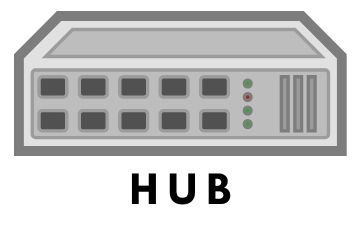
It is a networking device that is used to connect
multiple computers or other networking devices
in a series of connecting ports with
computers and other devices are connected.
It transfers data to all computers on the network.
It is used in a small network.

Switch
Switch is similar to a hub that has a series of ports for connecting computer networking devices. It sends the data to the destination computers only so it is an intelligent device. It is very popular nowadays and used in Star topology.

Bridge
A bridge is a networking device that joins the segment of similar network or dissimilar network that uses the same protocol. It helps to reduce traffic and improve network performance.

Router
It is a network connecting device that connects multiple networks having the same protocol. It can select the best path for transferring data among multiple parts.
Repeater
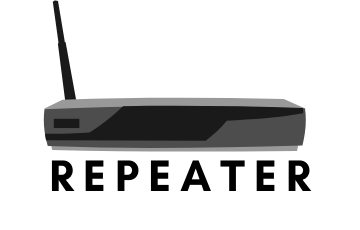
Repeater is a device that regenerates or amplifies signals. It makes the weak signal strong so that they can travel a long distance.
Gateway

It is a device or software that connects different networks having different protocols. It makes communication possible between two different networks.
Modem
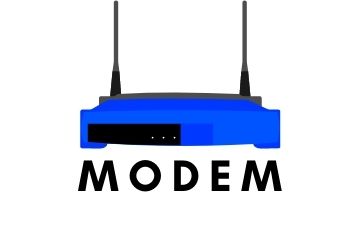
Modem is a device that converts digital signal into analog signal and vice versa. The process of converting digital to analog signal is modulation and analog to digital signal is known as the demodulation.





No comments: